Solutions

The same ledger, four different jobs

Head office, the warehouse, the shop floor and the accountant want different things from inventory. They should not need different systems to get them.

Multi-outlet retail

Know which shelf is empty before the customer does

Chains running ten to a few hundred outlets, where head office cannot phone every store and the POS only reports what sold, never what ran out.

  • One matrix across every outlet, refreshed as sales land
  • Reorder points per category and per outlet, not one number for the whole chain
  • Open pools to shift slow movers sideways instead of writing them off
Distribution and wholesale

Dispatch against demand, not against a spreadsheet

Warehouses serving outlets or dealers, where the cost of a stockout is a lost order and the cost of overstock is cash on a pallet.

  • Suggested reorder quantities rounded to pack size, net of what is already in transit
  • Dispatch queues that show what is approved, short or waiting
  • Inward documents that post the purchase and the stock together

Finance and accounts

The books agree with the shelf, because they come from the same document

Teams who keep their statutory books in Tally and are tired of re-keying the operational side into it.

  • Trial balance, P&L, balance sheet and ageing derived from posted vouchers
  • Import ledgers and the day book from Tally; re-import safely whenever you like
  • Every voucher traces back to the stock document that produced it

Operations and audit

Every number has a document behind it

Anyone who has had to explain a variance six weeks later, with nothing to go on but a changed cell.

  • Append-only stock ledger; corrections are new movements with reasons
  • Organization-wide audit log of who changed what, and what it was before
  • Role-based access checked on the server in every page, handler and action

In practice

Four days in the life

The paths people actually take, start to finish.

A delivery arrives at a warehouse

  1. 1The operator presses I from any screen and the inward dialog opens over it.
  2. 2Lines are scanned or searched; rates default to the product's cost price.
  3. 3Posting appends receipts to the stock ledger and posts the purchase voucher in the same transaction.
  4. 4Thresholds re-evaluate, and any open alert those units resolve closes itself.

An outlet is drowning in a slow mover

  1. 1The outlet opens a transfer to the pool rather than picking a destination.
  2. 2After approval and dispatch, the units leave its shelf and sit in the pool.
  3. 3Other outlets in the region see what is available and claim what they can sell.
  4. 4Whatever nobody claims returns to the source when the pool closes — as a real movement.

Month end, and the books need to agree

  1. 1The day book already holds every voucher the inward and outward documents produced.
  2. 2The Tally connector pulls the rest of the company's vouchers over the gateway.
  3. 3Trial balance, P&L and balance sheet are derived from posted vouchers, so they cannot drift.
  4. 4Ageing shows who is overdue, walked back from the invoices that make up each balance.

Something does not add up

  1. 1The stock ledger shows every movement behind the current figure, with source and actor.
  2. 2The audit log shows who changed a threshold, a product or a user, and what it was before.
  3. 3Corrections are movements with reasons, so a variance has a documented history.
  4. 4Cancelling a document reverses stock and withdraws its voucher — without deleting either.

On the floor

The portal is for the person at the shelf

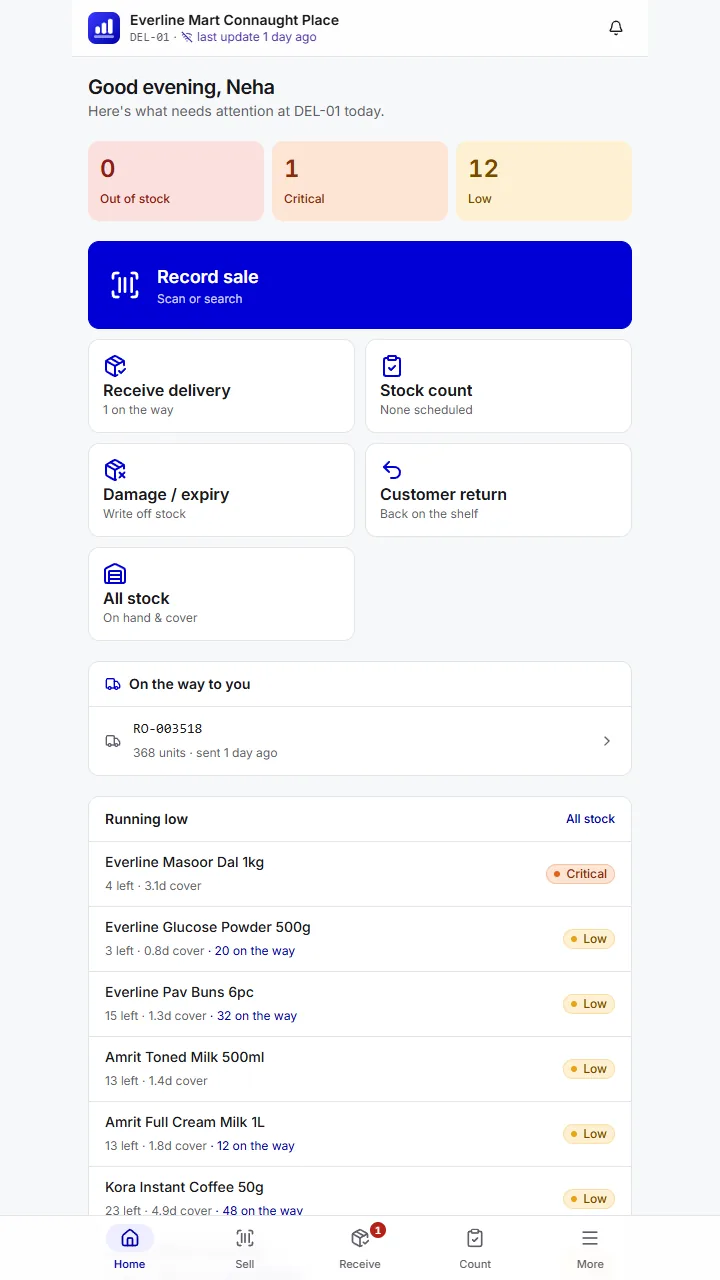
Outlet staff get a mobile workspace bound to their own outlet: barcode-first entry, blind counts, partial receipts, and nothing they are not allowed to see.

How the portal works
The mobile outlet portal showing quick entry for sales, receipts, counts and returns
The outlet portal: barcode-first, offline-tolerant, bound to one outlet.

Tell us what your week looks like

We will map it onto the product honestly — including the parts that would need work. Thirty minutes, no deck.